
Jefferson County Court Records After Arrest
A Jefferson County arrest can begin with the Sheriff's Office, a city police department, Wisconsin State Patrol, DNR, or another law-enforcement agency. The person may first appear in custody systems, including Wisconsin VINE or the JESO sheriff app. That does not make the booking note the final legal charge. The court record begins after prosecutor review and filing. In Jefferson County, the District Attorney's Office reviews police reports, decides whether criminal charges should be filed, and selects the charges that are appropriate for court.
The court side and the jail side answer different questions. Custody status, jail booking, and release alerts belong with jail inmate records. Booking photos, when available or requested, belong with jail mugshots. Court records after a jail arrest answer what charge was filed, what case number was assigned, when hearings were set, whether bond was ordered, and how each count ended. A person can be booked on one allegation and later face a different filed charge because the prosecutor, not the jail, controls charging decisions.
Jefferson County Arrest Charge Review
The Jefferson County District Attorney's Office is led by Monica Hall and is listed at 311 S. Center Avenue, C2150, Jefferson, WI 53549. The office phone is 920-674-7220, and published hours are Monday through Friday, 8:00 a.m. to 4:30 p.m. The county District Attorney program description says the District Attorney and Assistant District Attorneys are available to law enforcement throughout the county for legal advice on pending investigations. It also states that the office prosecutes state crimes, DNR violations, traffic and ordinance matters from the State Patrol and Sheriff's Office, juvenile delinquency matters, and several other statutory assignments.
The most important court-record point is local and practical: the District Attorney's Office determines whether charges should be filed and what those charges should be. Jail staff may record an arrest reason at intake, and a warrant may carry a local label, but the filed court record is built from the prosecutor's charging decision. That is why a Jefferson County court record after an arrest should be checked in WCCA before drawing conclusions from a booking note.
Find Jefferson County Court Records
Wisconsin Circuit Court Access, often called WCCA or CCAP, is the main public case-search path for Jefferson County criminal cases. The county warrant page gives a clear search pattern: agree to the WCCA terms, enter the person's last and first name, and change the county filter to JEFFERSON to pull open and closed county cases. A case number is a better search key when it is known, but name search is often the first path after a recent arrest.
| Field Label | Type | Required | Options / Format Notes |
|---|---|---|---|
| Terms agreement / I Agree | checkbox or button | yes | County instructions tell users to agree to WCCA terms and limits before searching. |
| Last name | text | yes for name search | Enter the defendant's last name as it may appear in court records. |
| First name | text | yes for name search | Use the first name to narrow common surnames. |
| County | dropdown | optional but important | Set county to JEFFERSON for open and closed Jefferson County cases. |
| Case number | text | optional path | Use when the case number appears on a bond paper, citation, or notice. |
| Search | button | N/A | Runs the search after terms and fields are complete. |
The WCCA circuit court case-search portal is the direct search screen for circuit court records. The Wisconsin Court System case-search hub also links to circuit court, Supreme Court, and Court of Appeals search tools. CCAP notes that courthouse WCCA access is available for people without internet access, so a person who cannot use the online portal can use courthouse access for statewide circuit court case information.
The WCCA portal screenshot in the research set shows the state circuit court case-search path used for Jefferson County court records after an arrest.
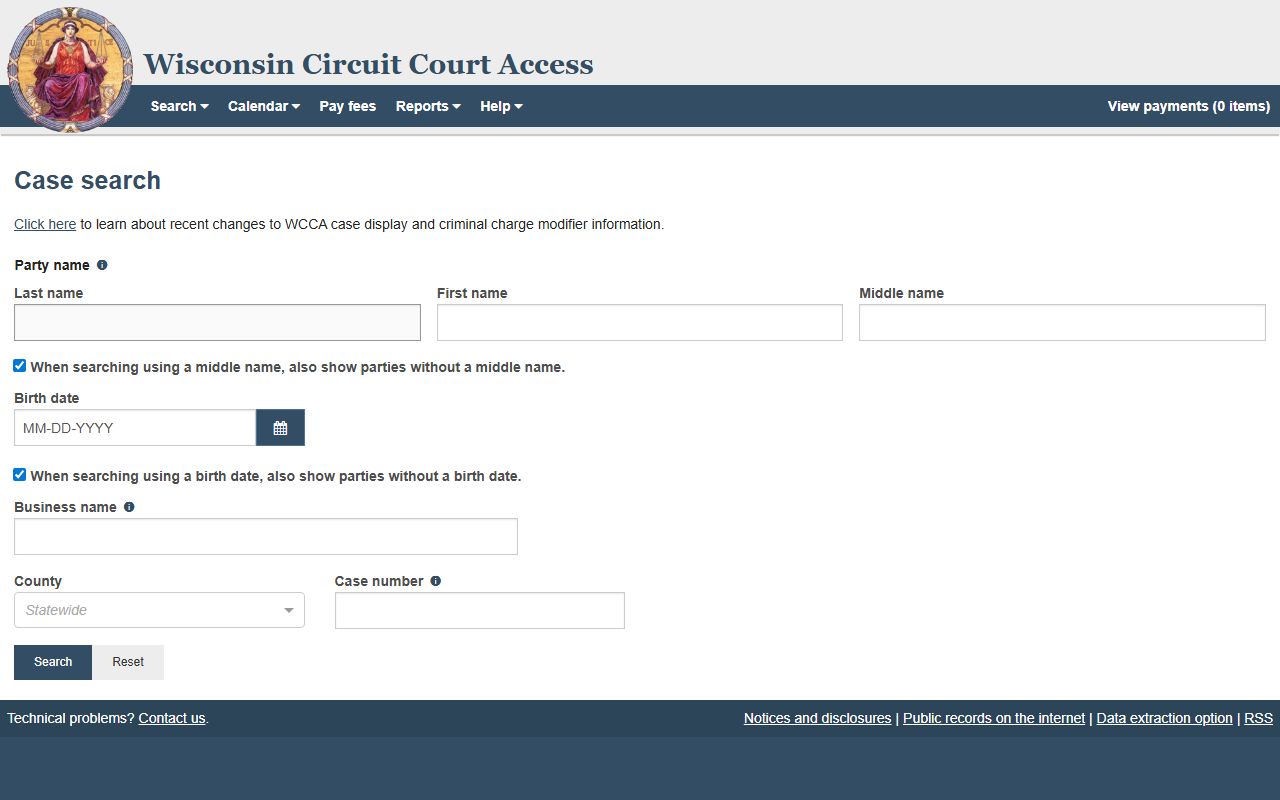
Use the county filter and the filing or offense date to separate the arrest-related case from older Jefferson County cases with the same name.
Look Up Court Records After Arrest
A recent arrest can take time to become a searchable court case. The jail may have a custody entry before the prosecutor files the complaint. If WCCA has no new case, check custody status first and search again after the next court business day. Names can also vary by spelling, middle initial, suffix, or former name.
- Confirm the person was booked or is in custody through VINE, the JESO app, or the jail phone line if the arrest is very recent.
- Open WCCA from the Wisconsin Court System or from official Jefferson County court and warrant links.
- Accept the WCCA terms and search by last name and first name, then set the county filter to JEFFERSON.
- Review open and closed cases, using filing dates and offense dates to connect the case to the arrest.
- Open the case summary and read each charge, statute citation, hearing, bond event, warrant entry, disposition, sentence, and financial obligation.
For documents not shown online, older files, or copies that must be certified, use the court clerk or courthouse access. For sheriff reports, jail records, or booking material, use the Jefferson County Sheriff's Office open-records process instead of treating WCCA as a complete police-record file.
Charging Records After Arrest
Charging documents explain why a criminal case exists. In a routine Wisconsin county case, the complaint is the common first document. Felony cases may later use an information after preliminary proceedings. An indictment is a grand-jury charging document and is less common in local Wisconsin practice than complaints and informations. WCCA may summarize charges, but the full document may require a court records request or courthouse access.
| Document | Who Files It | Typical Use | Why It Matters |
|---|---|---|---|
| Complaint | Prosecutor | Common charging document in Wisconsin criminal cases | Starts or supports the filed court case after arrest review. |
| Information | Prosecutor | Often used after preliminary process in felony matters | Can define the charge set that moves forward after early hearings. |
| Indictment | Grand jury | Less common for routine local cases | Charges by grand-jury action rather than a standard complaint path. |
Jefferson County Charge Status
Charge status is the part of a court record that prevents a search result from being reduced to one label. A charge can be filed, amended, reduced, dismissed, read in at sentencing, or resolved by conviction. If the person was arrested on a warrant, a warrant event or bond entry may also appear in the court activity. Read each count by its own status because one case can have mixed outcomes.
| Status | What It Means | How to Read It |
|---|---|---|
| Pending | The filed charge has not reached final disposition. | Check the next hearing and bond conditions. |
| Amended | The charge was changed after filing. | Compare the original and current charge description. |
| Reduced | The charge moved to a lesser offense. | Do not treat the first charge as the final conviction. |
| Dismissed | That count ended without conviction. | Other counts in the same case may still remain. |
| Convicted | The court entered conviction after plea, verdict, or finding. | Review sentence, costs, and supervision terms. |
| Read-in | The offense was considered at sentencing but not separately convicted. | It may matter at sentencing even without a count conviction. |
Bond Warrants and Arrest Records
Wisconsin Chapter 969 governs bail and release conditions. In Jefferson County, bond is a court issue, not a jail-only issue. The county's warrant page gives two useful local labels. A bondable warrant may be satisfied by paying a cash bond, subject to verification. A body-only warrant means the person needs to be seen by a judge. The Sheriff's Office tells users that all warrants are verified before action and that a person may go to a local law-enforcement agency or county jail to address an outstanding Jefferson County warrant.
The Jefferson County Most Wanted and warrants page also warns citizens not to restrain wanted persons. It links to the warrant list, child-support wanted information, WCCA instructions, and the Sheriff's warrant phone line at 920-674-7310. A warrant list is not the same as the court record. Use it to identify a possible custody issue, then use WCCA to check the related court case and current charge status.
| Bond / Warrant Term | Meaning in Context |
|---|---|
| Cash bond | Money paid to satisfy a bond amount or some bondable warrants. |
| Signature bond | A court promise to appear, sometimes with noncash conditions. |
| Body-only warrant | Local language for a warrant requiring judge appearance. |
| Hold or detainer | An outside agency, case, probation, parole, federal, or ICE issue that can block release. |
Charges vs Convictions
An arrest and a filed charge are not convictions. A charge is an accusation in a court case. A conviction is a court outcome after a plea, verdict, or finding. Public court records can show both, so each case has to be read to the disposition line instead of stopping at the first charge list.
| Point | Charge | Conviction |
|---|---|---|
| Stage | Filed accusation after prosecutor review | Final court result on a count |
| Proof | Begins from charging standards and probable cause | Requires plea, verdict, or court finding |
| Record use | Shows what was alleged and pending | Shows what was legally resolved as guilt |
| Risk | May be amended, reduced, dismissed, or read in | May affect sentence, supervision, fines, and future records |
Sealed vs Expunged Records
Wisconsin court access is shaped by public-records law, court display rules, and specific limits for protected case types. Wisconsin's public-records policy statute, Wis. Stat. 19.31, favors access subject to exceptions. Records access and fees are addressed in Wis. Stat. 19.35. Expungement is separate and is governed by Wis. Stat. 973.015, which is case-specific and generally depends on a court order tied to eligible offenses and successful sentence completion.
| Point | Sealed or Restricted | Expunged |
|---|---|---|
| Basic effect | Public access is limited by law, court rule, or case type. | Eligible record is removed from public court access after the required order and conditions. |
| Common source | Juvenile, confidential, protected, or security-sensitive information. | Wisconsin expungement statute and sentencing order. |
| Not automatic | Restriction depends on the record and legal basis. | Not every dismissal or completed case qualifies. |
| Where to verify | Court clerk or originating agency. | Court file and expungement order. |
Juvenile records, protected victim or witness information, medical material, active investigations, and jail security details may be withheld or restricted. A missing online entry does not prove that no arrest occurred, and a visible filing does not prove conviction. Use the originating court or agency when a record limit affects a legal decision.